
From Field to Faucet: The Invisible and Silent
Public Health Challenge
Prathna T.C. and Kiran Kesireddy
Across India, groundwater quality is undergoing a quiet yet consequential transformation. Rising concentrations of nitrate are increasingly being detected in groundwater, the primary source of drinking water for millions of rural and peri-urban households. Largely invisible and rarely monitored at scale, this contamination poses a growing public health concern.
Nitrates in water: why does it matter?
Nitrate is one of the most pervasive chemical contaminants found in groundwater worldwide. Its high solubility allows it to move easily through soils, enabling rapid leaching into shallow aquifers. Because nitrate does not alter the colour, taste, or smell of water, contamination often goes unnoticed until revealed through laboratory testing- by which point exposure may already be widespread.
The public health implications, however, are far from benign. Globally, nitrate in drinking water is most strongly linked to methemoglobinemia [1], commonly known as blue baby syndrome, a potentially fatal condition in infants that reduces the blood’s ability to carry oxygen. While the Bureau of Indian Standards (BIS) prescribes a threshold of 45 mg/L nitrate for safe drinking, both the World Health Organization (WHO) and the European Union have set a guideline value of 50 mg/L as the limit [2-4].
Beyond the well-established acute risks to infants, a growing body of evidence links long-term exposure to elevated nitrate concentrations with a range of chronic health outcomes. These include increased risks of gastro-intestinal disorders, colorectal [5] and breast cancers, primarily mediated through the endogenous formation of carcinogenic N-nitroso compounds. Emerging research further indicates associations with thyroid dysfunction and adverse reproductive outcomes [6].
In recognition of these health risks, several countries are moving toward more protective drinking-water standards. Notably, Denmark is currently working to reduce the permissible nitrate limit in drinking water from 50 mg/L to 6 mg/L, based on expert scientific recommendations [7].
Agricultural practices and nitrate leaching: the connection
While the green revolution boosted food production multifold it also brought with it consequences such as extensive fertilizer and pesticide use leading to health impacts [8] due to leaching. As per a Down to Earth article, the usage of fertilizers is uneven across India with 42% of the districts accounting for 85% consumption [9]. Besides, there are discrepancies in fertilizer use based on chemical ratios. The situation is grimmer in agriculture intensive states like Punjab and Haryana (~224 kg/ha each) and Telangana (~245 kg/ha) applying well above the all-India average of ~133 kg/ha [10].
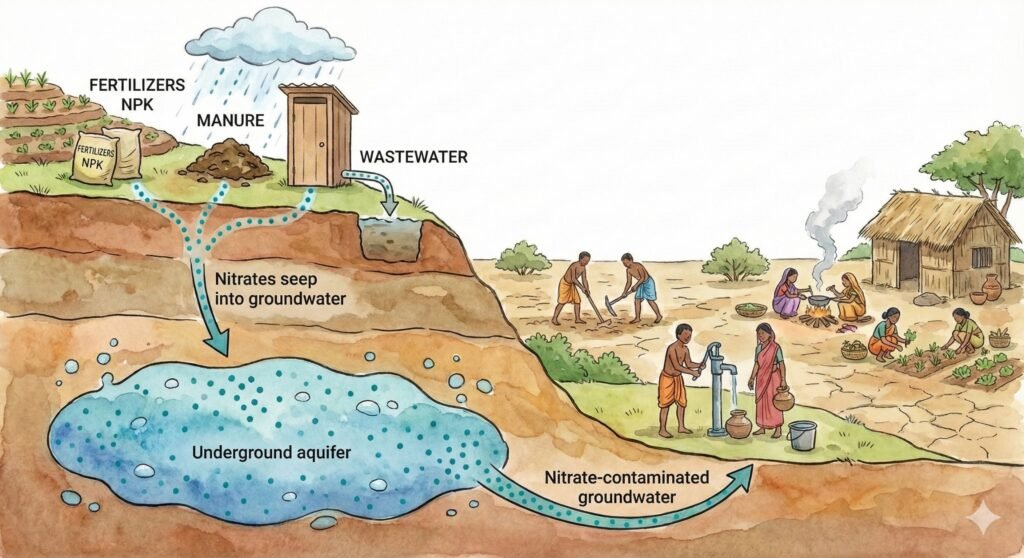
Nitrate contamination follows a well-established pathway (Figure 1). Crops absorb only a portion of applied nitrogen. The remaining nitrogen is converted by soil microbes into nitrate, which dissolves easily in water and moves downward with rainfall and irrigation. Once below the root zone, nitrate accumulates in groundwater aquifers. In addition to excessive fertilizer usage, improperly managed wastewater seeps into groundwater leaching nitrates.
Figure 1: Representative image indicating the flow of nitrates in the ecosystem
Why is it important for Rural India?
A recent assessment by the Central Ground Water Board (CGWB) indicates that over 50% of India’s districts report groundwater sources with nitrate concentrations exceeding permissible limits [11]. Elevated nitrate concentrations reflect region-specific interactions among climate, aquifer vulnerability, soil characteristics, irrigation practices, and cropping systems, compounded by intensive fertilizer use and limited natural attenuation. The map developed by Resilience Actions (Figure 2) highlights three major hotspot regions: the north-western alluvial plains, central peninsular hard- rock regions, and intensively cultivated southern states.
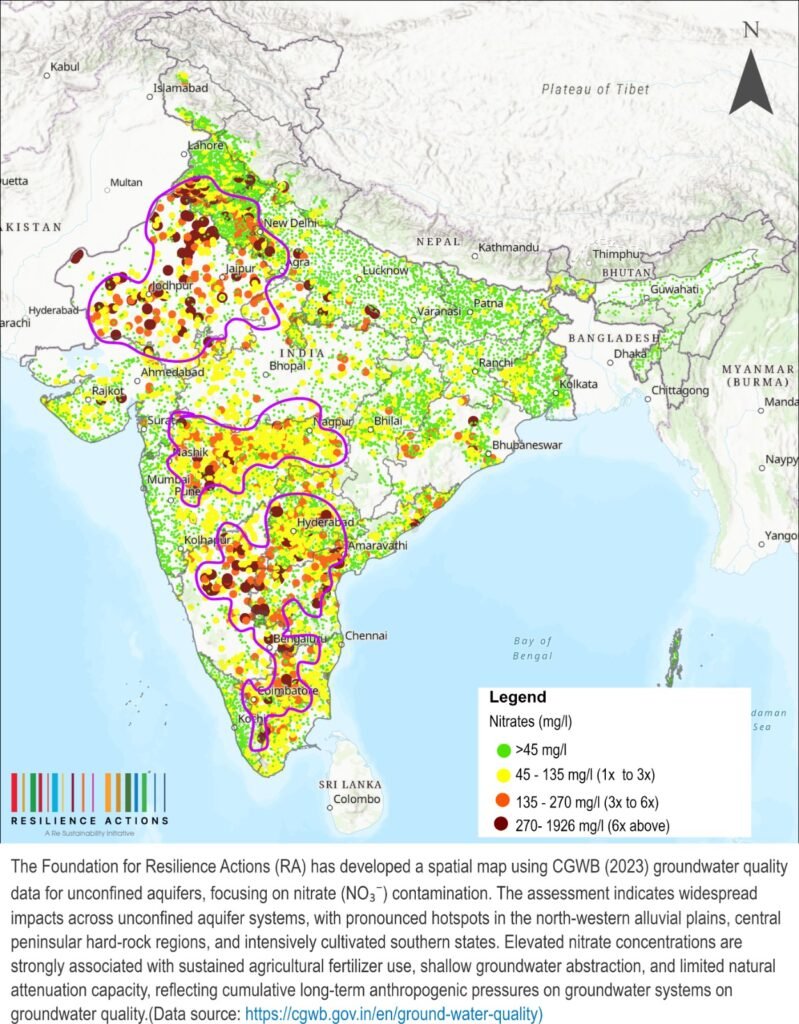
Figure 2: Spatial map showing nitrate contamination in groundwater across India (Data source: CGWB [11])
In the north-western alluvial plains, including the Malwa region, semi-arid conditions, shallow and highly permeable aquifers, and groundwater-intensive irrigation support high nitrogen- demand crops. Central peninsular hard-rock regions are vulnerable due to shallow fractured aquifers, thin soil cover, and strong monsoon-driven recharge following prolonged dry. In intensively cultivated southern states, humid climates with multiple cropping seasons accelerate nutrient loading from frequent fertilizer application periods.
As part of our initiatives (Behtar Bachpan), we undertook assessments in certain regions of Punjab analyzing surface and groundwater samples. The visit revealed the emergence of nitrates in groundwater as a major contaminant which has a potential to impact maternal as well as child health. This confirms the emergence of nitrates as a major contaminant in our groundwaters as reported by CGWB. Traditional household pre-treatment methods such as boiling worsens nitrate concentrations in water and therefore there is a need to raise awareness as well as identify solutions.
What Needs to Change Now
Lower the Safety Bar, Not the Protection: Reassess and progressively reduce permissible nitrate limits in drinking water based on emerging health evidence
Nitrate safe water solutions: The scientific and innovation community should focus on delivering non-RO, decentralised nitrate-safe drinking water solutions that are field-proven, community-operable, and low in energy and maintenance requirements.
Shield Women and Children from Chronic Exposure: Prioritise high-risk habitations for safe water alternatives, household treatment options, and health awareness efforts and integrate quality monitoring into rural drinking water systems
Test Consistently: Expand groundwater surveillance to include regular nitrate testing at source and household levels
Apply Fertilisers Based on Soil Reality, Not Habit: Use soil test- based nutrient recommendations to guide fertiliser type, quantity, and timing, reducing excess nitrogen application
Target Extension Where Vulnerability Is Highest: Focus farmer outreach and advisory services in regions with shallow aquifers and intensive cultivation.
Connect Water, Agriculture, and Health at the Local Level: Align actions across drinking water, agriculture, groundwater, and public health systems to ensure nitrate mitigation efforts reinforce each other on the ground.
References
[1] Fewtrell, L. (2004). Drinking-Water Nitrate, Methemoglobinemia, and Global Burden of Disease: A Discussion. Environmental Health Perspectives, 112, 1371-1374. Available at: https://pmc.ncbi.nlm.nih.gov/articles/PMC1247562/
[2] World Health Organization (2022). for drinking-water quality: fourth edition incorporating the first and second addenda Available at: https://iris.who.int/server/api/core/bitstreams/69c17edd-ee26-425b-9d34-33799377e886/content. (Date Accessed 20th December 2025)
[3] European Union Drinking Water Directive (2020). Directive 2020/2184 of the European Parliament and of the Council of 16 December 2020 on the quality of water intended for human
Consumption. Available at: https://eur-lex.europa.eu/legal-content/EN/TXT/PDF/?uri=CELEX:32020L2184 (Date Accessed 20th December 2025)
[4] Bureau of Indian Standards (2012). Drinking Water Specification BIS 10500. Available at: https://cpcb.nic.in/wqm/BIS_Drinking_Water_Specification.pdf (Date Accessed 20th December 2025)
[5] Jacobsen, B.H., Hansen, B., Schullehner, J. (2024). Health-economic valuation of lowering nitrate standards in drinking water related to colorectal cancer in Denmark. Science of the Total Environment. 906, 167368. Available at: https://www.sciencedirect.com/science/article/pii/S0048969723059958
[6] Iowa Environmental Council (2016). Nitrate in Drinking Water. A public health concern for all Iowans. Available at: https://www.iaenvironment.org/webres/File/Nitrate_in_Drinking_Water_Report_ES_Web.pdf (Date Accessed 20th December 2025)
[7] MARCHES (2025). International experts recommend lower limit value for nitrate in drinking water. Available at: https://projects.au.dk/marches/news/international-experts-recommend-lower-limit-value-for-nitrate-in-drinking-water (Date Accessed 20th December 2025)
[8] John, D.A. and Babu, G.R. (2021). Lessons From the Aftermaths of Green Revolution on Food System and Health. Frontiers in Sustainable Food Systems. 5, 644559. Available at: https://pmc.ncbi.nlm.nih.gov/articles/PMC7611098/
[9] Jitendra (2016). 42% of India’s districts use 85% of its chemical fertilisers. Down to Earth. Available at: https://www.downtoearth.org.in/agriculture/42-of-india-s-districts-use-85-of-its-chemical-fertilisers-55267 (Date Accessed 20th December 2025)
[10] Ministry of Agriculture and Farmer`s Welfare (2019). Unequal use of fertilizers and pesticides. PIB Delhi. Available at: https://www.pib.gov.in/PressReleasePage.aspx?PRID=1594209®=3&lang=2 (Date Accessed 20th December 2025)
[11] Central Ground Water Board (2023). Ground water quality data. Available at: https://cgwb.gov.in/sites/default/files/inline-files/final_nhs-wq_pre_2023_compressed.pdf (Date Accessed 20th December 2025)